Can LLMs accelerate software requirements engineering?

Bill Doerrfeld | March 6, 2025

New research shows AI tends to outperform humans in software requirements

There's a lot of AI-bashing going on right now (And I know I've stoked the fire a bit 😅). But I still see a lot of positives in using it, especially for other areas ancillary to the actual act of coding... one area is software requirements.


Studies show poor requirements are the leading cause of software project failures (InfoTech, 2024). Other reports find that setting these guidelines up front is correlated with success. But, ironically, this is an area often minimized in project roadmaps.


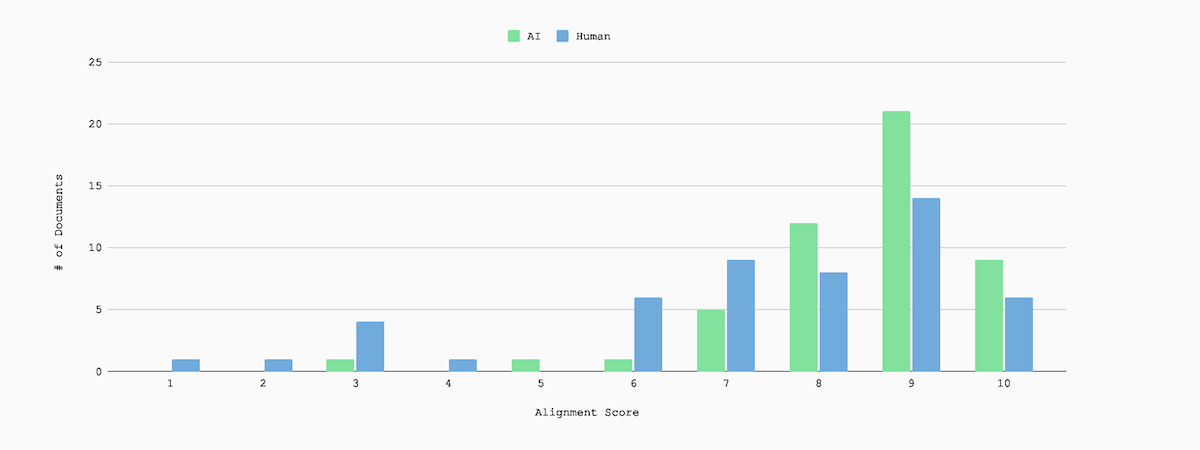
According to new research from Crowdbotics, LLMs outperform human requirements generation on average, slimming a process that takes 2-4 weeks into seconds. They tend to enhance completeness by 10.2% and lead to slightly better alignment at a fraction of the cost.


Cory Hymel, VP of Research and Innovation at Crowdbotics, sees using AI as having big implications for requirements engineering. "It'll become bifurcated like everything else — either you'll either use AI, or you'll fall behind."


Of course, human-in-the-loop matters here, as it's hard to capture everything, like environmental factors, company culture, and access to internal data. "Having humans in the mixture helps bring creativity into the mix," he says. 


Just thought I'd give a shoutout to some explorations on the sidelines of AI-generated code, which seems to take up most of the literature on using LLMs in software engineering.


I'll be curious to see if engineering leaders agree. Are you seeing the benefits of embedding LLMs into the requirements engineering phase? Or does it still pose too many gaps in practice?
Humans versus LLMs requirements engineering software Crowdbotics study 2025
By Bill Doerrfeld February 28, 2026
While hardware usually gets the spotlight in physical AI, the real differentiator won't be hardware. It'll be the models.
By Bill Doerrfeld February 27, 2026
In the latest DirectorPlus, Workato's CTO explains how MCP-enabled integration catalyzed internal AI usage and ROI.
By Bill Doerrfeld February 18, 2026
My latest on InfoWorld reviews MCP servers from 5 major cloud providers
By Bill Doerrfeld February 18, 2026
How are organizations actually using agentic knowledge bases in practice? My article for The New Stack looks at six emerging patterns.
eBPF in Production Report
By Bill Doerrfeld February 12, 2026
My report for the eBPF Foundation explores enterprise eBPF case studies, production deployments, and real business outcomes across cloud-native environments.
Close-up of whole bean coffee Bottomless
By Bill Doerrfeld February 10, 2026
Longtime Bottomless user sharing why I love automated coffee delivery triggered by a smart scale, plus a referral link for a free first bag.
By Bill Doerrfeld February 5, 2026
MCP servers can quickly drain context windows without guardrails. Thankfully, there are ways around this, say the experts.
By Bill Doerrfeld February 4, 2026
It may seem like AI agents are suddenly doing everything across industries. But in reality, the pace of agentic AI is moving carefully, and very deliberately, in highly regulated environments like finance and banking.
By Bill Doerrfeld February 3, 2026
My latest feature for InfoWorld explores when it makes sense to scrape public web sources, and when official API integrations are the better choice for external data.
By Bill Doerrfeld January 30, 2026
What does it mean to go nano with your software updates — to "carve with a scalpel" instead of swinging a hammer? For my latest DirectorPlus piece, I caught up with Chainguard VP Dustin Kirkland to dig into that idea.